I wanted to post some updates on Gypsy, the six year old Appendix Quarter Horse mare I picked up a month ago. She is a perfect example of how ignorance is never a good excuse. I never actually met or talked to the people who starved and neglected her. I purchased her for $400 from the girl who rescued my mare and an even more emaciated gelding. She only had Gypsy for two weeks before I bought her. She had a farrier give her a first trim, and had been feeding her grass hay. She did not worm her or have her teeth checked. Needless to say, Gypsy was still in poor shape. I'm not suggesting the girl who rescued her didn't do a good job. Her intention was simply to get her out of a bad situation and find her a home that would rebilitate her and her buddy, and she did just that.
To recap, this was Gypsy the day after I brought her home:

These were her hooves:

You can also see another view of her hooves in my last post. Remember that his was AFTER a first trim. You can not simply trim back severely over grown hooves or the horse will be very lame. It takes allot of time and effort to get them back where they need to be.
Because of her dark color and her semi-long hair, her weight is somewhat masked. Even with an inch of winter hair growing in, you could still count her ribs in the photo. (I know she looks slicked out. it was very bright that day, the sun was setting, and she still managed to get a shine. No, she doesn't have a full winter coat, but she wasn't slicked out either. Look at the fur on her belly, how its ruffled up a bit.) In person, her sorry state was even more evident. Her withers jutted, her spine stuck up above her back about an inch, and her hips were all but wasted away. Not only were they severely sunken, but the muscle had been eaten up. Her neck was stick-like and she had something of a pot belly going on.
I started her on a Safeguard Power-Dose pack of de-wormer. I've also used a Panacur Powerpac before, but have found they both work effectively. Before I start the Power-Dose, I always worm a half dose of a normal syringe, and then worm a whole dose a few days later to make sure there is no sudden mass of dying worms that would cause a horse to colic. She didn't seem super wormy anyways, but I wanted to make sure we killed any and all worms. I still need to go get some Tapercare to treat tapeworms. I plan on picking that up later this evening. I scheduled an appointment with our vet to come and look at our teeth. When he came out, he said she had never had her teeth floated in her life. She had hooks on both the front and back about 1 1/2 inches long. They had left furrows and scars in her gums. He was surprised she could eat at all.
After her teeth were done, I started her slowly on grain. I had been feeding her alfalfa up to that point, gradually increasing the amount until she was basically getting as much as she could eat. (By this time I had owned her for a week.) Now I started her on a mix of rice bran and a commercial pelleted feed. At this point, she gets two scoops of rice bran and two of the pelelted feed every day. I measured the poundage, but I can't remember off the top of my head what it is. She got another trim the day after she came to me, another two weeks later, and then a third yesterday. I don't have pictures of the recent trim, but her feet are finally the proper length. Now we have to worry about getting her heels back up as they are severely underslung. 15 minutes a day of hand walking on pavement is helping that.
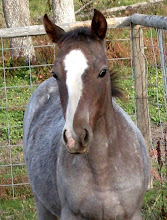
This is Gypsy today, after a full month of good feed, proper dental care, worming and hoof maintanence:

She still has progress to make, but she has come along way. In the first photo, if you enlarged it, you could count six or seven ribs. Now you can only count three or four. Not only that, but this photo is after a month of wearing a heavy blanket. All of her hair under the blanket was slicked down, instead of fluffy and long as in the first photo. (It looks like she has more hair, but its simply very cloud and gloomy, so there is no shine.) She has filled out over the top of her croup. Her withers are far less prominent and her spine is not sticking up in the least. Her neck has thickened considerably.
And guess what? It didn't cost me an arm and a leg! Fixing her teeth cost me slightly more than a routine float because of the amount of work that had to be done. I have studied with farriers and do my own horses hooves unless special shoes, etc. are needed. It costs slightly more to feed her as she requires double that to gian rather than maintain, but it still isn't something as insane as the cost of a surgery, etc. A powerdose of wormer was about $80 rather than the $13 I usually pay to deworm a horse (who has been on a proper rotation). The point is that it wouldn't have cost that much to upkeep her in the first place. She gains easily. Lets break down the costs if she needed maintanence only. My vet charges $100-$120 for a normal float. This only has to be done once a year. If they did her feet every 6 weeks thats probably about $40 every two months. Add $13 every two months to de-worm her, and now all you have on top of that is feed.
I mean come on! Maybe the people were ignorant and were feeding her but she just kept losing. Perhaps the fact she couldn't CHEW was a factor? Or that fact that worms may have been stealing all of the nutrition? If you don't know how to properly care for a horse, don't own one!!!
Here is photo of her feet after the last trim. She has had one more since then:

As you can see, her right front had a few more problems, but its much better now. Surprisingly, even with hooves that were curling up, she maintained the symmetry. They are nice and even feet with healthy tissues.
I've ridden her a few times and have been doing allot of slow groundwork with her. Lots of teaching her to move the shoulder and hip, to yield to pressure, to respect my space, to disengage her hindquarters, to flex on the ground, to change direction on a line, etc. I've only ridden her at a walk and all we have done is practiced bending and yielding to leg pressure, stopping and backing, changing directions, etc.. The same things we are doing on the ground. She needs the exercise to rehab her poor muscles, particularly her atrophied hips. Nothing too strenuos though, I don't want to slow down the weight gain. This week we'll start introducing potentially "scary" things. Pop cans, plastic bags, tarp monsters, loud noises, flags, swinging ropes, etc. and see how she responds. I want to take her to some tryouts in a couple of months when she is full weight for a film horse. :)

No comments:
Post a Comment